Bodybuilding has always been surrounded by misinformation, exaggerated claims, marketing gimmicks, and outright lies. From supplement companies promising extraordinary muscle growth to gym veterans repeating outdated training advice, separating fact from fiction can be difficult, particularly for beginners. Even experienced bodybuilders sometimes fall victim to popular myths that have been repeated for decades.
The bodybuilding industry is worth billions of dollars, and there are plenty of businesses and individuals who benefit from keeping people confused. Some sell unnecessary supplements, others promote questionable training methods, and many influencers exaggerate their achievements to attract followers and sponsorships.
Unfortunately, believing these myths can waste money, slow progress, increase injury risks, and create unrealistic expectations about what building an impressive physique actually requires.
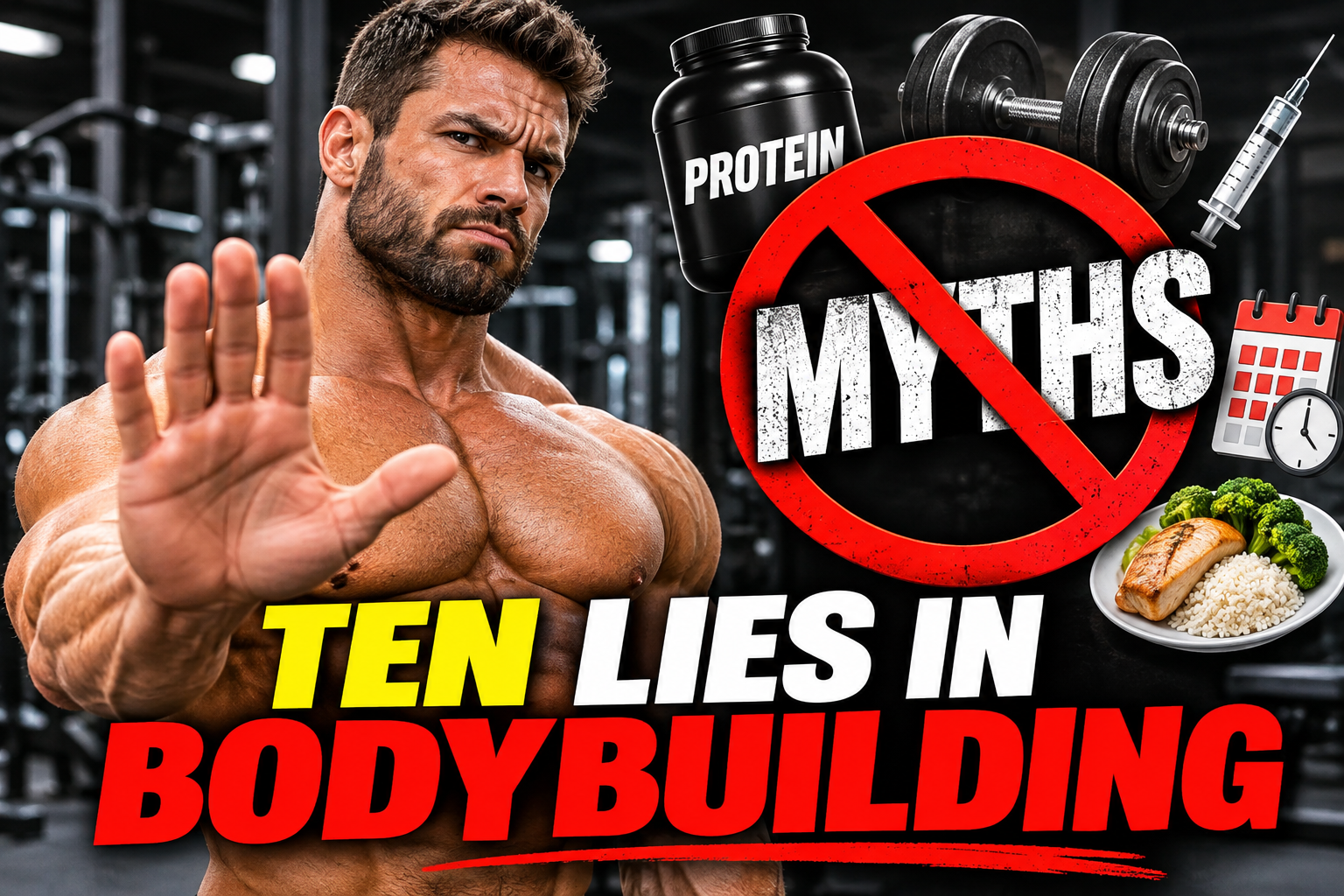
Here are ten of the biggest lies in bodybuilding that deserve closer examination.
You Must Train Every Day to Build Muscle
One of the most persistent bodybuilding myths is that serious athletes must spend time in the gym every single day to achieve significant muscle growth. This belief is often reinforced by professional bodybuilders who post pictures of themselves training six or seven days per week.
However, muscle growth does not happen exclusively inside the gym. Resistance training provides the stimulus for adaptation, but recovery is an essential part of the process.
During recovery, the body repairs damaged muscle tissue and adapts to the demands placed upon it. Insufficient rest, inadequate nutrition, and poor sleep can interfere with this process.
Training frequency should depend on individual recovery capacity, experience, exercise selection, and overall workload. Some individuals make excellent progress training three or four days weekly, while others prefer more frequent sessions with carefully managed training volume.
More training is not automatically better training. Consistently pushing beyond your ability to recover can produce diminishing returns and potentially increase the likelihood of overuse injuries.
The truth is that an effective bodybuilding program needs sufficient training stimulus balanced with adequate recovery. Spending seven days in the gym does not automatically make someone a better bodybuilder.
You Need Expensive Supplements to Build Muscle
Walk into almost any supplement store and you will find products promising increased strength, explosive muscle growth, enhanced recovery, and extraordinary physical transformations.
The marketing can make beginners believe that building an impressive physique requires an expensive collection of powders, capsules, and performance formulas.
This is nonsense.
The foundation of bodybuilding is progressive resistance training, adequate nutrition, sufficient protein, and recovery. Supplements may help address particular nutritional needs or provide convenience, but they cannot replace these fundamentals.
Protein powder, for example, is simply a convenient way to increase daily protein intake. Someone who already consumes sufficient protein through ordinary foods does not necessarily need an additional protein supplement.
Creatine monohydrate is one of the better-researched sports supplements and has demonstrated benefits for high-intensity exercise performance and strength development. However, it is not a requirement for building muscle.
Many other products have considerably weaker evidence supporting their advertised benefits.
The supplement industry frequently uses impressive scientific terminology, celebrity endorsements, and dramatic before-and-after photographs to encourage purchases.
The truth is that a person can build an excellent physique without spending hundreds of dollars every month on supplements.
You Must Eat Every Two Hours
The idea that bodybuilders must eat six, seven, or even eight meals daily is another longstanding myth.
For decades, bodybuilding magazines and fitness personalities promoted frequent meals as essential for maintaining an anabolic environment and preventing muscle breakdown.
Although meal frequency can influence convenience, appetite management, and the distribution of protein intake, eating every two hours is not a biological requirement for muscle growth.
Research suggests that total daily protein intake and overall nutritional quality are considerably more important than following an unnecessarily complicated eating schedule.
For someone trying to build muscle, consuming adequate calories and protein throughout the day matters far more than eating at precisely timed intervals.
Some athletes prefer five or six smaller meals because they find it easier to consume enough food. Others prefer three substantial meals and perhaps a snack.
Both approaches can work.
There is also no magical metabolic advantage to eating continuously throughout the day. The body does not suddenly begin losing muscle because someone goes four hours without eating.
The truth is that bodybuilding nutrition should be practical and sustainable. A meal schedule should accommodate an individual’s lifestyle, training routine, appetite, and nutritional requirements rather than follow arbitrary rules.
More Protein Always Means More Muscle
Protein is essential for muscle development, and bodybuilders understandably pay considerable attention to their daily intake.
However, the belief that consuming increasingly large quantities of protein will automatically produce increasingly large muscles is misleading.
Muscle protein synthesis requires amino acids, but there are limits to how much additional benefit someone receives from continually increasing protein consumption.
Research examining resistance-trained individuals generally supports daily protein intakes around 1.6 grams per kilogram of body weight as sufficient for maximizing average muscle-building benefits, with approximately 2.2 grams per kilogram providing a useful upper target for many individuals.
Individual requirements can vary depending on calorie intake, training experience, body composition, and other circumstances.
Consuming substantially more protein does not compensate for inadequate training, insufficient calories, or poor recovery.
Furthermore, excessive focus on protein can cause people to neglect carbohydrates and dietary fats. Carbohydrates support demanding training sessions, while dietary fats contribute to normal hormonal function and other important physiological processes.
A balanced bodybuilding diet should contain all three macronutrients.
The truth is that protein is important, but consuming more than the body can effectively use for its nutritional needs does not guarantee additional muscle growth.
You Can Turn Fat Directly Into Muscle
This is one of the most frequently repeated misconceptions among people beginning their bodybuilding journeys.
Someone starts lifting weights, begins losing body fat, and notices that their muscles appear larger and more defined. They conclude that their body fat has somehow transformed into muscle tissue.
Unfortunately, human physiology does not work that way.
Fat tissue and muscle tissue are completely different biological structures. One cannot directly convert into the other.
When someone loses body fat, their body reduces stored energy reserves. When someone builds muscle, their body increases muscle tissue through the adaptation of muscle fibers to resistance training.
These are separate processes.
However, it is possible to lose fat and build muscle simultaneously. This is commonly called body recomposition.
Beginners, individuals returning after a prolonged training break, and people carrying higher levels of body fat may be particularly capable of achieving this.
Progressive resistance training combined with appropriate protein intake and controlled calorie consumption can support both processes.
The visual transformation can be impressive, but it does not mean fat has turned into muscle.
Understanding this distinction helps bodybuilders establish realistic expectations and develop better nutritional strategies.
You Must Lift Extremely Heavy Weights
There is a popular belief that building serious muscle requires lifting the heaviest possible weights in every exercise.
Walk into almost any gym and you will see individuals loading enormous amounts of weight onto barbells, sometimes sacrificing proper technique simply to move the load.
While progressive overload is an important principle of bodybuilding, constantly lifting maximal weights is neither necessary nor particularly sensible.
Muscle hypertrophy can occur across a relatively broad range of resistance loads when sets are performed with sufficient effort and appropriate proximity to muscular failure.
Heavy weights are useful for developing strength, but moderate and lighter loads can also stimulate muscle growth.
The important considerations include mechanical tension, sufficient training effort, appropriate exercise selection, and progressive adaptation.
For example, someone performing controlled sets of ten to twelve repetitions with appropriate resistance can achieve substantial hypertrophy without attempting maximal lifts.
Extremely heavy training also places greater demands on joints, connective tissues, and the nervous system.
This does not mean heavy lifting is inherently dangerous. It means that training loads should match the individual’s experience, technique, and objectives.
The truth is that effective bodybuilding is not a competition to see who can lift the most weight. Building muscle requires consistent, intelligently programmed resistance training.
Women Will Become Huge From Lifting Weights
Despite decades of evidence supporting resistance training for women, the belief that lifting weights will automatically produce an excessively muscular physique remains surprisingly common.
Some women avoid resistance training because they fear developing large muscles or losing their feminine appearance.
This concern is largely unfounded.
Building substantial muscle mass requires years of consistent training, appropriate nutrition, progressive overload, and favorable individual characteristics.
Testosterone plays an important role in muscle development, and average circulating testosterone concentrations are considerably lower in women than in men.
Consequently, women generally develop muscle at a slower rate and achieve less absolute muscle mass through comparable natural training programs.
This does not mean women cannot become exceptionally muscular. Female professional bodybuilders demonstrate that extraordinary muscular development is possible, although achieving that level of development involves highly specialized training and, in some cases, performance-enhancing drugs.
For most women, resistance training provides benefits that extend far beyond appearance. These include improved strength, bone health, physical function, and body composition.
The truth is that lifting weights does not automatically make women excessively muscular. It is one of the most effective ways to develop a stronger, healthier physique.
You Must Change Your Workout Every Week
Another common bodybuilding recommendation is to constantly change exercises, training routines, repetition ranges, and workout structures to prevent the muscles from adapting.
This is often marketed as muscle confusion.
The problem is that muscles do not need an entirely different workout every week to continue growing.
In fact, constantly changing exercises can make it more difficult to measure progress. If someone performs completely different workouts every session, determining whether strength and performance are improving becomes challenging.
Progressive overload requires some degree of consistency. Bodybuilders need opportunities to improve their performance through increased resistance, additional repetitions, improved technique, or other measurable training adaptations.
This does not mean performing identical workouts indefinitely.
Exercise selection can be adjusted when progress stalls, recovery becomes problematic, or an individual’s goals change. Periodically modifying training volume and intensity can also be beneficial.
However, changes should have a purpose rather than simply being introduced because someone believes the muscles have become bored.
Muscles do not possess the ability to become bored with an exercise.
The truth is that a well-designed training program should provide enough consistency to measure progress while allowing sensible adjustments when necessary.
You Must Have Perfect Genetics to Become Muscular
Genetics undoubtedly influence bodybuilding potential.
Factors such as muscle insertions, skeletal structure, muscle fiber characteristics, hormonal differences, and natural muscular development can influence how an individual responds to training.
Some people naturally develop muscle more easily than others, while certain individuals possess physical characteristics that are particularly advantageous for competitive bodybuilding.
However, genetics are frequently used as an excuse for poor training, inconsistent nutrition, and unrealistic expectations.
Most people have considerably more potential for muscular development than they realize when beginning resistance training.
A person does not need exceptional genetics to become significantly stronger, build an impressive physique, or improve their body composition.
Genetics become particularly important when discussing elite bodybuilding competition, where relatively small differences in muscular development, proportions, conditioning, and structure can determine placings.
For the average recreational bodybuilder, however, consistency and proper training principles are far more relevant than winning the genetic lottery.
The truth is that genetics influence the final result, but they do not eliminate the benefits of disciplined training and proper nutrition.
Steroids Are the Only Way to Build an Impressive Physique
This final myth is particularly common in modern bodybuilding discussions, especially across social media platforms.
Some people believe that anyone with an impressive physique must be using anabolic steroids or other performance-enhancing drugs.
There is no question that anabolic-androgenic steroids can significantly increase muscle growth and strength. Their effects on muscle protein synthesis, recovery, and training adaptations are well established.
However, claiming that steroids are the only way to develop an impressive physique is simply incorrect.
Natural bodybuilders have demonstrated for decades that substantial muscular development is possible without anabolic drugs.
The distinction is that natural bodybuilding generally involves different limits, timelines, and expectations.
A natural athlete may need many years of consistent training to develop a muscular physique that someone using performance-enhancing drugs could potentially achieve more quickly.
Furthermore, professional bodybuilding should not be confused with recreational fitness. The extreme muscular development displayed on professional bodybuilding stages represents a very specialized level of the sport.
Performance-enhancing drugs also carry potentially serious health consequences, including cardiovascular complications, hormonal disruption, fertility problems, and psychiatric effects.
Their use should never be treated as a requirement for participating in bodybuilding.
The truth is that impressive physiques can be developed naturally, although the amount of muscle someone can ultimately build varies considerably between individuals.
The Truth About Bodybuilding
Bodybuilding has evolved enormously over the decades, with improved training research, nutritional science, and a better understanding of muscle physiology.
Unfortunately, misinformation has evolved alongside it.
Many of the industry’s most persistent myths survive because they are profitable, entertaining, or repeated by people who have never questioned their accuracy.
Building muscle does not require expensive supplements, endless hours in the gym, complicated meal schedules, or constantly changing workouts. It requires a consistent approach built around effective resistance training, appropriate nutrition, and sufficient recovery.
Perhaps the biggest lie in bodybuilding is that there is some secret method that guarantees extraordinary results.
There isn’t.
The people who make consistent progress generally understand the fundamentals, apply them over long periods, and avoid becoming distracted by every new training trend or supplement advertisement.
Ultimately, bodybuilding rewards patience, discipline, knowledge, and consistency far more than gimmicks and shortcuts.
References
1. American College of Sports Medicine (2026). Resistance Training Prescription for Muscle Function, Hypertrophy, and Physical Performance in Healthy Adults. Medicine & Science in Sports & Exercise.
2. International Society of Sports Nutrition (2017). Protein and Exercise: Position Stand.
3. Morton et al. (2018). A Systematic Review and Meta-Analysis of Protein Supplementation and Resistance Training. British Journal of Sports Medicine.
4. National Institutes of Health (NIH). Dietary Supplements for Exercise and Athletic Performance.
5. American College of Sports Medicine (2009). Progression Models in Resistance Training for Healthy Adults.
6. International Society of Sports Nutrition (2018). Exercise and Sports Nutrition Review: Research and Recommendations.